
Exploring the Impact of UV-A Light on Basil (Ocimum basilicum L.)

The Role of UV-A Light in Plant Physiology
Light is a fundamental environmental factor that influences plant growth, development, and stress responses. While the effects of ultraviolet (UV) radiation on plants have been extensively studied, the specific impacts of UV-A light (315–400 nm), particularly its wavelength and intensity, remain less understood. UV-A radiation is known to influence various plant processes, including photosynthesis, photomorphogenesis, and secondary metabolite production. Unlike UV-B, which primarily induces stress responses, UV-A can act as a photoregulatory signal, modulating plant growth and development. Recent advancements in LED technology and high-throughput phenotyping have opened new avenues for investigating how UV-A radiation affects plant physiology, morphology, and biochemical composition. These effects of UV-A are highly species-specific, dose-dependent, and influenced by environmental conditions.
A study conducted by Vodnik et al. (2023), examines the effects of supplemental UV-A light of different wavelengths (365 nm and 385 nm) and intensities on basil (Ocimum basilicum L.). It combines conventional physiological measurements, biochemical analyses, and high-throughput phenotyping to provide a comprehensive understanding of basil’s response to UV-A radiation. Four treatments combine baseline red–blue LEDs with UV-A at 365 nm, 385 nm, or both, at total intensities ranging from 3.5 to 16 W m⁻² (E1–E4). Plant traits are assessed using 3D multispectral scanning, chlorophyll fluorescence imaging using the CropReporter, and biochemical analyses of pigments and phenolic compounds.
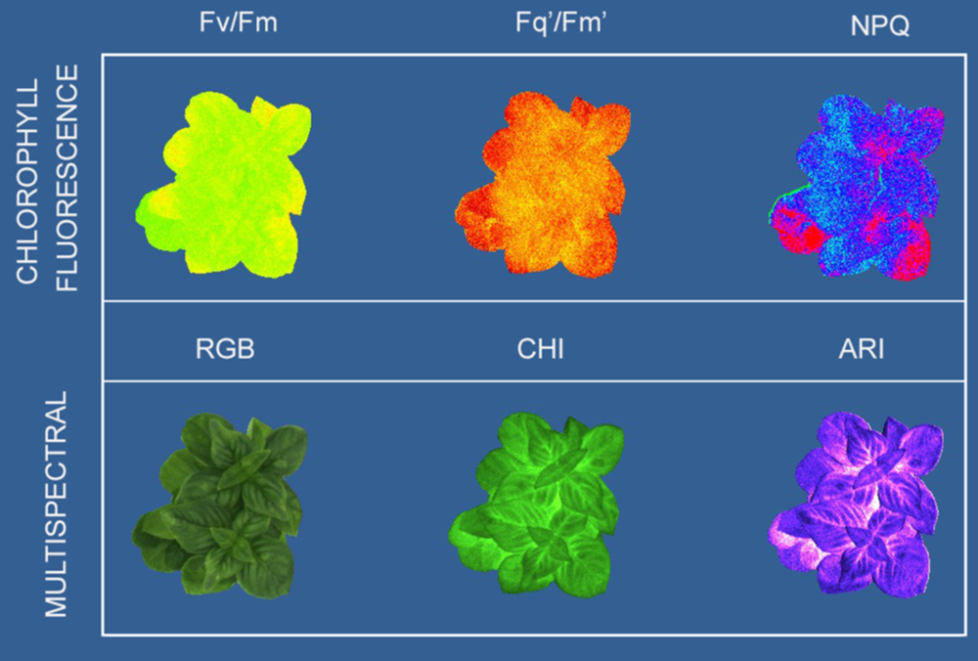
Basil showed high tolerance to UV-A. across all treatments, including the highest intensity. No negative effects were detected in biomass, plant height, leaf area, or digital volume. Morphological development remained consistent with the control lighting conditions. UV-A did not reduce photosynthetic efficiency. Higher UV-A doses yielded increased effective quantum yield (Fq'/Fm') and electron transport rate (ETR), indicating improved photochemical performance. The rise in xanthophyll cycle pigments (VAZ) and VAZ-to-chlorophyll ratios suggested activation of photoprotective mechanisms that help prevent photoinhibition.
Although anthocyanin accumulation was not observed, the Anthocyanin Index increased under UV-A, likely reflecting structural or spectral changes. UV-A exposure induced a dose-dependent rise in hydroxycinnamic acid derivatives, such as rosmarinic acid-glucoside and caffeic acid-glucoside, which act as UV screens and antioxidants. Glycosylation enhances their stability and strengthens basil’s oxidative stress defense. Basil’s UV-A tolerance appears to rely on enhanced thylakoid electron transport, increased photoprotective pigments, and the upregulation of antioxidant phenolics. Together, these mechanisms maintain photosynthetic efficiency and mitigate UV-induced stress.
The findings indicate that UV-A can be safely integrated into LED lighting strategies to improve plant resilience and increase valuable secondary metabolites. High-throughput phenotyping tools such as multispectral 3D scanning and chlorophyll fluorescence imaging support precise monitoring and optimization of light regimes in indoor farming systems.
Conclusion
This study demonstrates that basil exhibits remarkable tolerance to UV-A radiation, thanks to a combination of enhanced photosynthetic efficiency, protective pigment accumulation, and metabolic adaptation. The integration of high-throughput phenotyping with conventional physiological and biochemical analyses provides a holistic understanding of UV-A responses, paving the way for innovative lighting strategies in horticulture.
For further details, please explore the original publication:
- Vodnik, D., et al. (2023). Phenotyping of basil (Ocimum basilicum L.) illuminated with UV-A light of different wavelengths and intensities. Scientia Horticulturae. DOI: 10.1016/j.scienta.2022.111638