Tips and Tricks for Writing a Tender for a Plant Phenotyping System
The tender document decides two things: which system you get, and what it really costs to run it for five years. Write it well and offers become comparable. Write it vaguely and you compare brochures.
Most tenders for plant phenotyping systems are written by plant physiologists, not procurement experts. That is a strength: you know what you need to measure. But it also means that data rights, licences, service and running costs are often missing. Those are exactly the points that decide whether a system is still useful in year four. Technical requirements are another blind spot, and that is no surprise for a plant expert. A colour camera is not just a colour camera: two cameras with the same resolution can give very different results. Pixel size, sensor noise, dynamic range, colour accuracy, lens quality and illumination together decide whether the images are good enough for reliable measurements.
Below are eight steps to write a tender that gives you clear offers, a fair comparison and no surprises after delivery.
Step 1: Start from the research question, then think wider
Describe what you want to learn before you describe the machine. A supplier can only offer the right configuration if it knows the biology behind the request.
Include in the tender:
• The research questions for the next five years, and which ones may come later
• Crops and plant sizes: species, maximum height and width, pot or tray format
• Number of plants per experiment and measurements per day
• The traits you need: for example growth, colour, photosynthesis efficiency (Fv/Fm, ΦPSII, NPQ), multispectral indices (NDVI, chlorophyll and anthocyanin index), 3D traits (plant height, leaf area, leaf angle), hyperspectral reflectance
• The environment: growth chamber, greenhouse or field, and the available floor space
But do not stop at your own project. A system that does one thing perfectly is nice for your project, but your group or university will use it for many years and many questions. Often, for the same budget or only a little more, you get extra parameters that make the system useful for colleagues and future projects too.
So write down what you need, and also write down your dreams. Mark them clearly as wishes, not requirements. This way the supplier can show how much of your wish list is possible within your budget, and you may find that more is within reach than you expected.
Step 2: Write functional requirements that you can test
Ask for what the system must do, not for a specific product. Public tenders in the EU may not name a brand without adding "or equivalent". Functional requirements also give suppliers room to offer better solutions.
Make every requirement measurable. Compare:
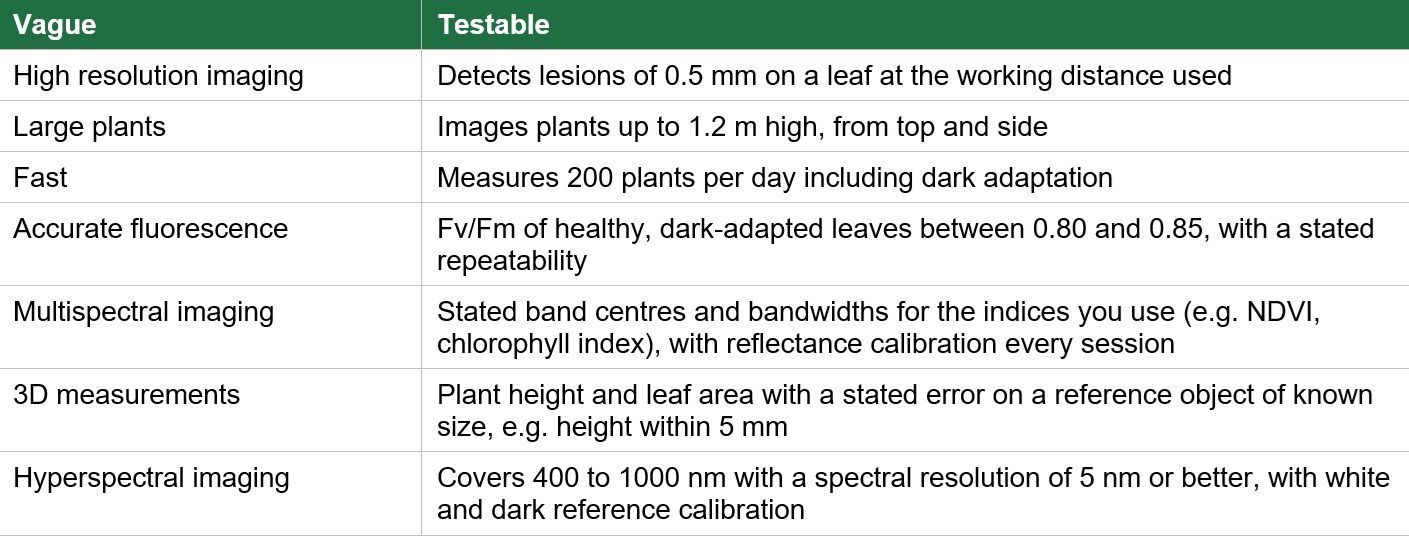
Split requirements into must-haves (knock-out criteria) and nice-to-haves (scored). Keep the must-have list short. Every unnecessary knock-out criterion removes good offers from the comparison.
Step 3: Ask for a test with your own plants
A demo with the supplier's best plants shows what the system can do on a good day. A test with your plants shows what it will do for your project.
Ask suppliers to measure a small, defined sample set: your crop, your pot format, a control group and a stressed group. Ask for the raw images, the processed results and a short description of the analysis steps. Then compare the results against each other and against what you know about the plants.
Step 4: Put data, software and licences in writing
These clauses are the most often forgotten, and the most expensive to fix later. Add them as requirements, not as questions.
1. Data access without supplier software. All data, including raw data before any correction, must be exportable in open, documented formats (for example TIFF, PNG, CSV, HDF5 or RAW). Include the metadata and calibration files needed to reproduce the results.
2. Transparent processing. The supplier describes every correction and calculation applied between raw data and final result.
3. Right to run your own analysis. The licence explicitly allows you to analyse all data with your own scripts or third-party software. Do not assume this is allowed: check the licence terms, also as a university.
4. No measurement behind a time-limited licence. All parameters the system measures at delivery remain measurable when a software subscription ends. If not, the supplier states which functions stop and what continuing costs per year.
Why this matters: a grant usually pays the purchase, but recurring licence fees come from the running budget. When that budget is gone, a system with a lapsed licence can stop being useful, even though the hardware still works.
Step 5: Make costs comparable with a fixed cost table
A demo with the supplier's best plants shows what the system can do on a good day. A test with your plants shows what it will do for your project.
Ask suppliers to measure a small, defined sample set: your crop, your pot format, a control group and a stressed group. Ask for the raw images, the processed results and a short description of the analysis steps. Then compare the results against each other and against what you know about the plants.
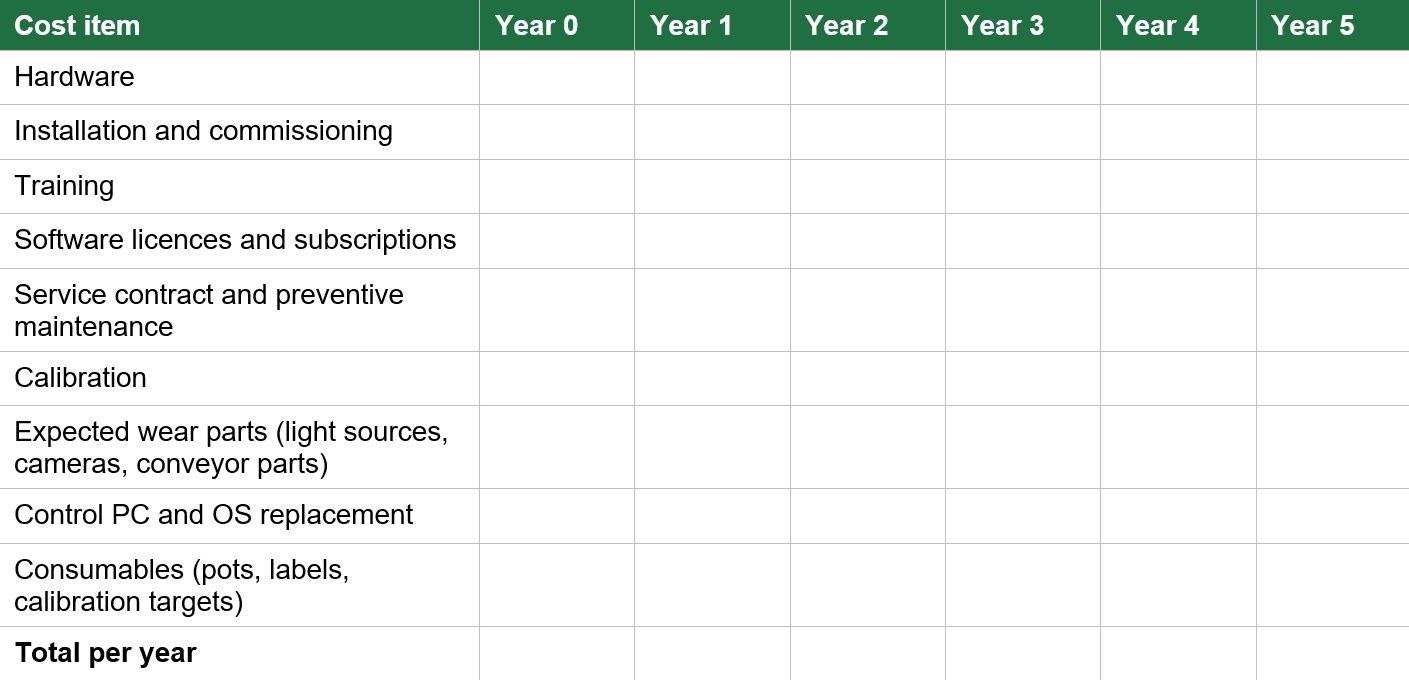
Add your own internal costs: floor space, energy, IT support and staff time. Then divide the total by the number of years. That cost per year, or cost per measured plant, is the number to compare.
Ask suppliers to state which prices are fixed and which are indexed. A licence that rises 5% per year is a different offer from a fixed one.
Step 6: Secure service, spare parts and lifetime
A phenotyping system often runs for ten years or more, far longer than one project. Ask for commitments that cover that lifetime:
• Warranty period, and what it covers (parts, labour, travel)
• Guaranteed availability of spare parts, for example for ten years after delivery
• Response time for remote support and for an on-site visit
• Whether remote diagnosis is possible, and under which IT security conditions
• Software updates: how long they are supplied, and whether they are included
• Operating system support: will the software run on the next Windows or Linux version?
•
References from users who have run the same system for at least three years
Step 7: Define acceptance tests and training
Decide in the tender how you will check that the delivered system meets the requirements. Without an acceptance test, "working" means whatever the supplier says it means.
1. Factory acceptance test (optional): the system is tested at the supplier before shipping.
2. Site acceptance test: after installation, every must-have requirement from Step 2 is tested on site, with agreed test plants or reference targets.
3. Payment link: the final payment, for example 10 to 20%, follows after a passed site acceptance test.
Also specify training: how many days, for how many users, and whether it covers data export and your own analysis, not only operating the system.
Step 8: Set clear award criteria and weights
In public procurement in the EU, contracts are usually awarded on the best price-quality ratio, not on lowest price alone. That gives you room to reward quality, but only if you define it upfront.
An example weighting:
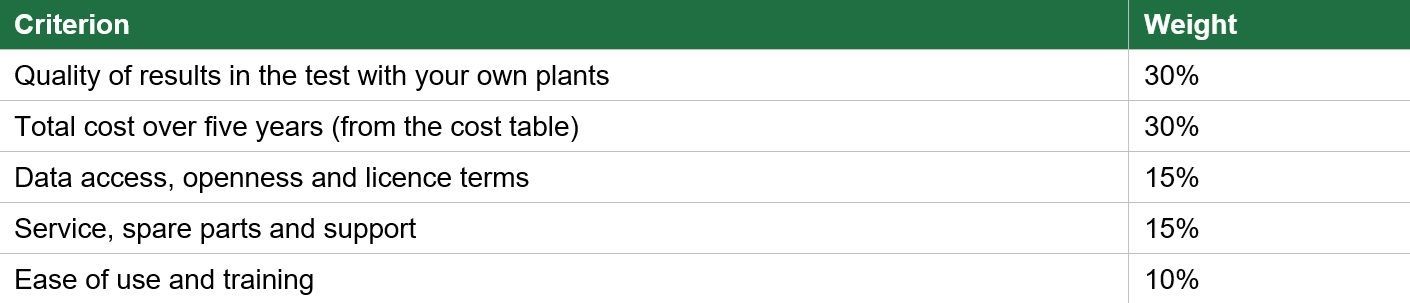
Score against the cost per year from Step 5, not against the purchase price. Publish the scoring method in the tender, so suppliers know what you value and write their offers accordingly.
Checklist for your tender
To make the start easier, we have prepared standard tender documents for a photosynthesis imaging systems. The template contains the steps from this blog: functional requirements, data and licence clauses, a 5-year cost table and acceptance tests. Download the one that fits your project, adapt it to your research question and use it freely in your own tender.
• Tender template: Photosynthesis (chlorophyll fluorescence) camera – [link]
The template is free to use, change and share.
A good tender takes more time to write, but it saves you from five years of surprises. And it helps suppliers too: the clearer the question, the better the offer.
Which point would you add to this list?