
Vertical Phenotyping: Integrating 2D PSII Efficiency with 3D RGB Point Clouds
Climate change is pushing crops to their limits. Drought, salinity, and waterlogging are no longer rare events but recurring challenges that threaten global food security. To breed resilient varieties, we need to see what’s hidden, not just the upper leaves basking in sunlight, but the lower canopy layers where stress responses often begin. Traditional phenotyping tools, like 2D chlorophyll fluorescence imaging, provide valuable insights into photosynthetic performance (e.g., PSII efficiency, or Fq’/Fm’). Yet, they fall short in one critical way: they average values across the entire top-down view, overrepresenting upper leaves and masking the responses of lower, often more stress-sensitive layers.

This blind spot is more than a technical limitation, it’s a barrier to understanding how crops truly cope with abiotic stress. Without vertical resolution, breeders risk overlooking traits that could define the next generation of climate,resilient crops.
A novel framework developed by Vlaardingen et al. (2026) shatters this limitation by integrating 2D top-view chlorophyll fluorescence imaging (CropReporter) with 3D structural data (MaxiMarvin). The result? A spatial map of PSII efficiency across canopy layers, revealing vertical heterogeneity in photosynthetic activity that was previously invisible.
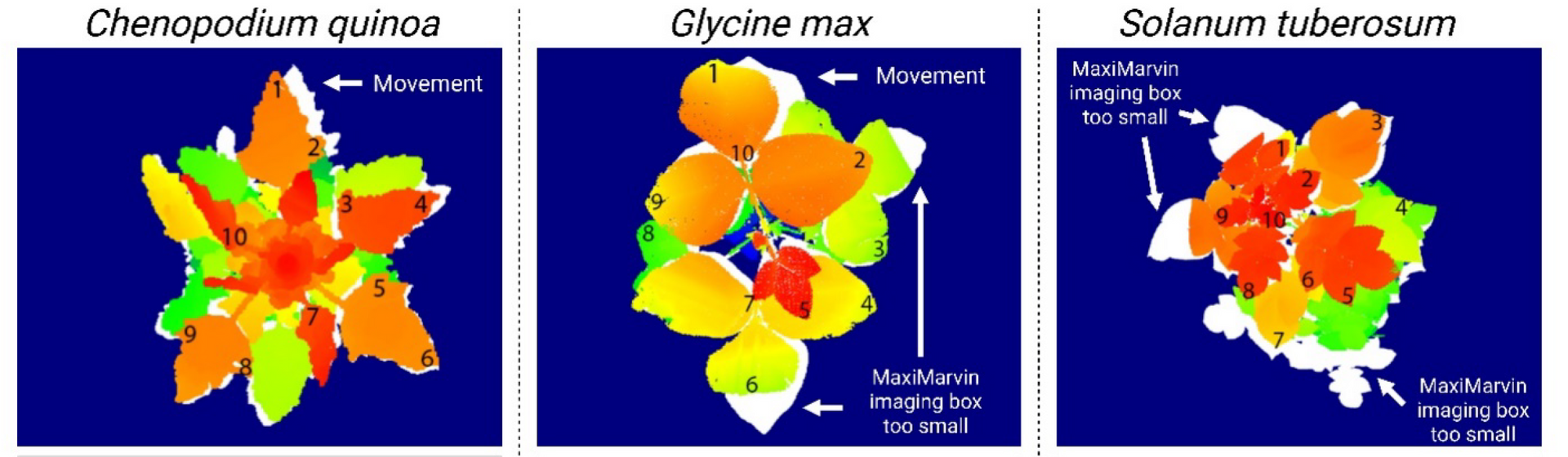
The alignment is remarkably precise, with R² ≥ 0.98 for x- and y-coordinates across diverse crops like quinoa, soybean, and potato. This means researchers can now;
- Visualize and quantify PSII efficiency in distinct leaf layers, from the youngest leaves to the oldest.
- Filter out non-photosynthetic tissues (e.g., flowers, seeds) that bias whole-plant averages.
- Track developmental and stress-induced changes in photosynthetic performance with unprecedented spatial resolution.
Whether it’s the early senescence of lower leaves in quinoa, the layer-specific sensitivity of middle canopy leaves in soybean under waterlogging, or the uniform systemic decline in drought-stressed potatoes, vertical resolution provides unprecedented detail, enabling breeders to target traits in vulnerable canopy layers, agronomists to refine precision management, and researchers to validate stress models with empirical, layer-specific data. In an era of increasing climate volatility, vertical phenotyping is not just an advantage, it’s a necessity for developing crops that thrive under stress.
The integration of 2D chlorophyll fluorescence imaging with 3D structural data represents more than a technical advancement, it is a shift in how we understand plant resilience. By moving beyond the limitations of flat, averaged data, this framework unlocks the layers of photosynthetic activity, offering precision in breeding, agronomy, and stress physiology research.
As climate change intensifies, spatial precision in phenotyping will be indispensable. This 2D-3D integration method not only corrects biases in traditional imaging but also scales efficiently for high-throughput applications. Its adaptability, extending to parameters like Fv/Fm, NPQ, and multispectral indices, ensures it remains at the forefront of phenotyping innovation.
Ultimately, this approach empowers us to detect early stress signals, track developmental changes, and refine crop models with a level of detail that was previously unattainable. In a world of increasing climate volatility, tools like this are not just valuable—they are essential for developing crops that don’t just survive, but thrive. The future of resilient agriculture begins with seeing the full picture.
Explore the full study:DOI:10.1186/s13007-026-01536-3
PhenoVation’s CropReporter:PhenoVation.com
NPEC’s MaxiMarvin:NPEC.nl