
The Power of the Red Edge: Using Gitelson’s Methods for Chlorophyll Measurement
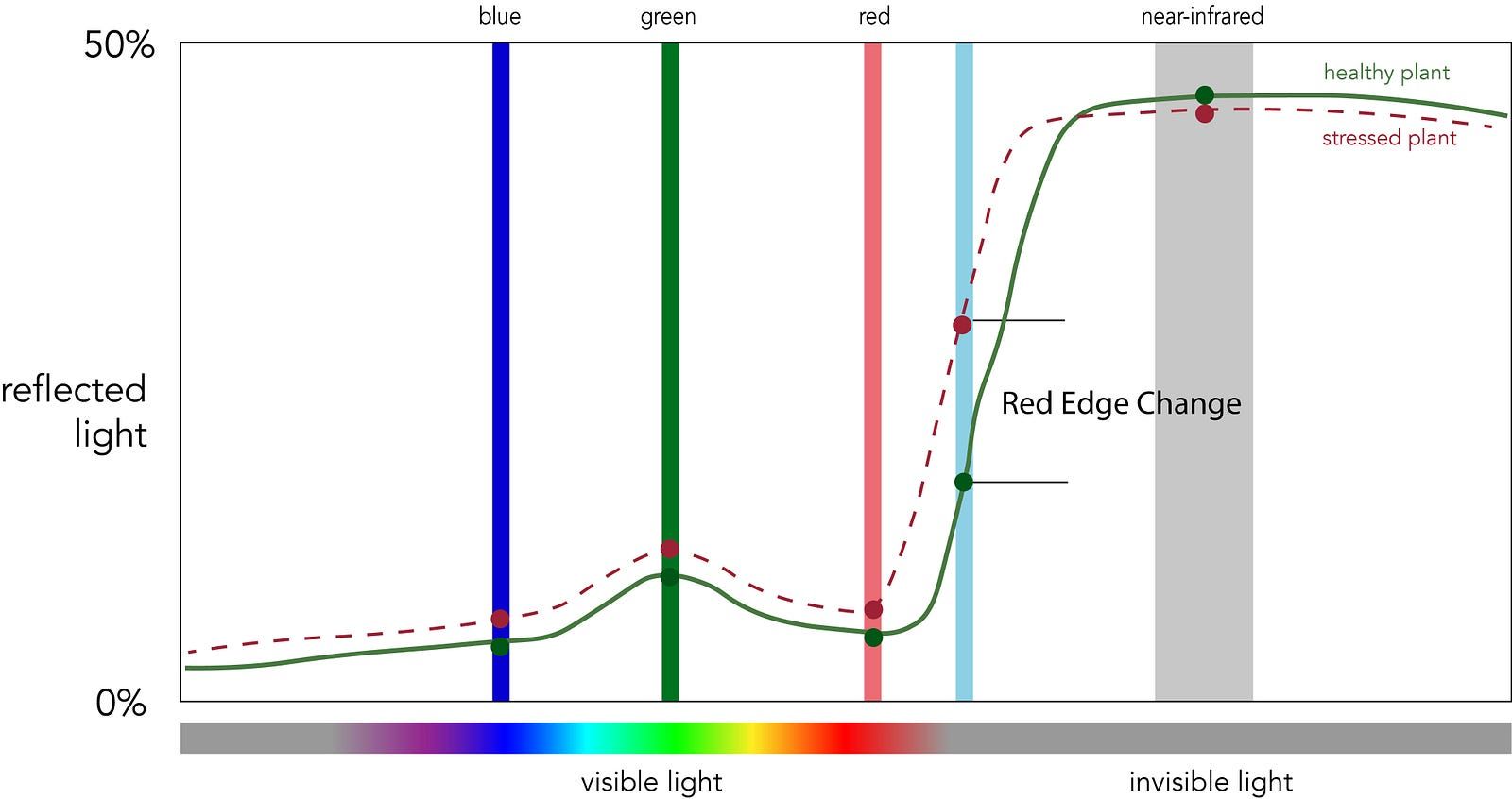
According to Gitelson et al. (2003), the most accurate way to estimate chlorophyll content from reflectance measurements is to use the following algorithm:
Chlorophyll Index=(RNIR/Rλ)−1
where:
RNIR is the reflectance in the near-infrared (NIR) range (e.g., 750–800 nm).
Rλ is the reflectance in the green (520–585 nm) or red edge (695–740 nm) regions.
Gitelson et al. (2003) provide three key reasons for the superior accuracy of this approach:
1. Linear Relationship with Chlorophyll Content
The authors found that reciprocal reflectance (Rλ)−1 in the green (520–585 nm) and red edge (695–740 nm) regions is linearly proportional to total chlorophyll content across a wide range of species and chlorophyll concentrations (1–830 µmol/m²).
In the blue (400–500 nm) and red (600–680 nm) regions, the relationship is non-linear and saturates at higher chlorophyll levels (>150 µmol/m²), making these regions less reliable for accurate estimation.
By subtracting the reciprocal reflectance in the NIR range (RNIR)−1 from (Rλ)−1, the authors created an index:
[(Rλ)−1−(RNIR)−1]
This subtraction eliminates the intercept (background noise) and makes the index linearly proportional to chlorophyll content across the entire range (1–830 µmol/m²).
2. Correction for Leaf Structure Variations
Impact of Leaf Structure: Leaf thickness, density, and internal scattering can vary significantly between species and even within the same plant. These structural differences affect reflectance, especially in the NIR range, where light scattering is dominant.
To account for structural variations, Gitelson et al. multiplied the index by RNIR:
[(Rλ)−1−(RNIR)−1]⋅RNIR=(Rλ/RNIR)−1
This adjustment reduces sensitivity to leaf thickness and density, making the algorithm more robust across different species and leaf structures.
3. Minimal Sensitivity to Pigment Composition
The slope of the relationship between (Rλ)−1 and chlorophyll content is consistent in the green and red edge regions (520–585 nm and 695–740 nm) across different species. In contrast, the slopes in the blue and red regions vary widely, leading to less accurate estimates.
The coefficient of variation for the slope of the relationship (Rλ)−1 vs. chlorophyll is minimal (<10%) in the green and red edge regions, ensuring high accuracy regardless of species or pigment composition.
The algorithm was validated using independent datasets (maple and beech leaves) and achieved an RMSE of less than 49 µmol/m² for chlorophyll estimation, which is significantly lower than other tested indices (e.g., R800/R680 or (R800−R680)/(R800+R680)).
Gitelson et al. compared their algorithm with several previously developed indices (e.g., Blackburn 1998, Datt 1998) and found that their approach provided the lowest RMSE and the most linear relationship with chlorophyll content.
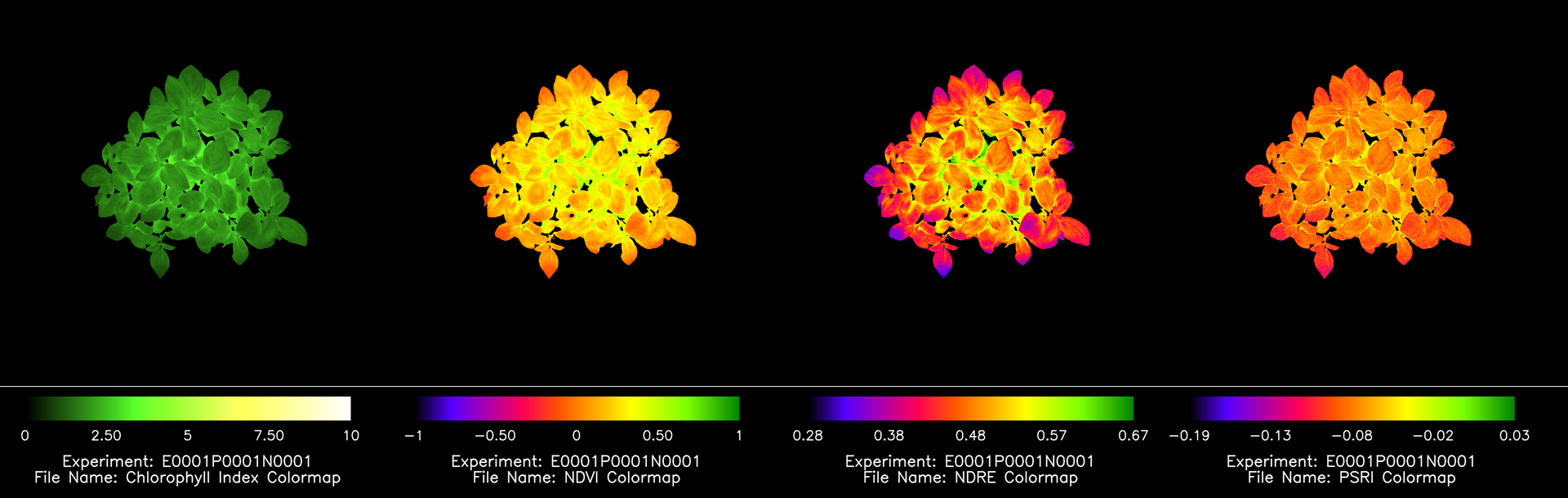
For further details, we encourage readers to explore the original publication:
Gitelson, A.A., Gritz †, Y., Merzlyak, M.N., (2003). Relationships between leaf chlorophyll content and spectral reflectance and algorithms for non-destructive chlorophyll assessment in higher plant leaves.
Journal of Plant Physiology 160, 271–282. https://doi.org/10.1078/0176-1617-00887