Chlorophyll Fluorescence Imaging Reveals the Hidden Stress of Weeds Under Mechanical and Chemical Control
Weeds remain one of agriculture’s most persistent challenges, competing with crops for water, nutrients, and sunlight, often leading to significant yield losses. While chemical herbicides and mechanical weeding are the most common control methods, their precise effects on weed physiology, and how weeds respond to these stresses, have not been fully explored. A recent study by Quan et al. (2023) in Frontiers in Plant Science sheds light on this issue by using chlorophyll fluorescence imaging to monitor how weeds react to mechanical and chemical damage.

The researchers focused on two common weed species: Digitaria sanguinalis (large crabgrass) and Erigeron canadensis (Canadian fleabane). Using PhenoVation’s PlantExplorer KS, a mobile chlorophyll fluorescence imaging system, they tracked changes in key photosynthetic parameters, such as Fv/Fm (maximum quantum yield of PSII) and ETR (electron transport rate), to assess how different stress treatments affected weed health.
One of the most striking findings was the site-specific impact of chemical stress. When the herbicide glufosinate was applied to different parts of the weeds, the leaf underside (abaxial surface) showed the most severe damage, with a photosynthetic inhibition rate (R) of 75% after seven days. This suggests that herbicides penetrate more effectively through the leaf underside, possibly due to differences in cuticle structure or stomatal distribution. The study also noted that Erigeron canadensis, with its dense leaf trichomes, exhibited a slower response to chemical stress compared to Digitaria sanguinalis, highlighting the importance of species-specific responses in weed management.
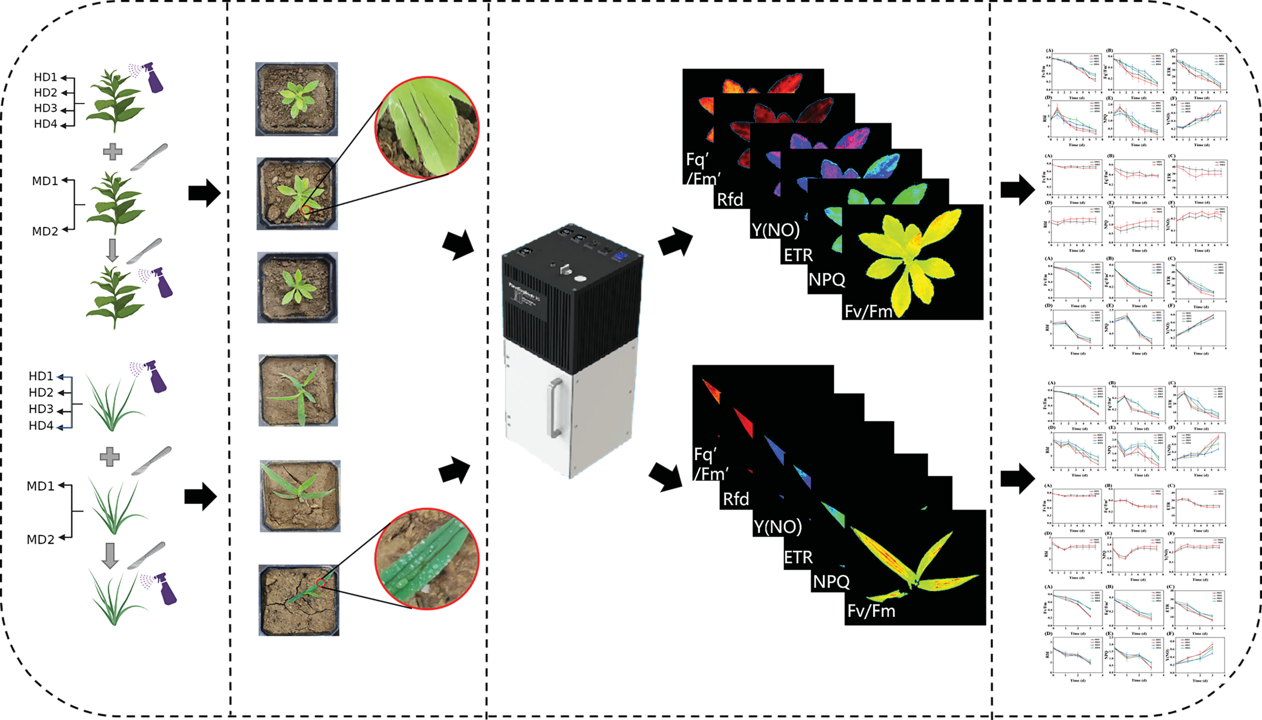
Mechanical stress, simulated by scratching the leaves to mimic weeding machinery, resulted in a short-term decline in photosynthetic efficiency, followed by partial recovery within one to two days. The photosynthetic inhibition rate (R) for severe mechanical stress was 11%, significantly lower than that of chemical stress. Unlike chemical damage, which is often irreversible, mechanical stress triggered a transient physiological response, with parameters like Fv/Fm and ETR initially dropping but beginning to recover after 48 hours. However, severe mechanical damage—affecting more than 50% of the leaf area—led to more pronounced and lasting effects, indicating that the degree of injury plays a critical role in weed survival.
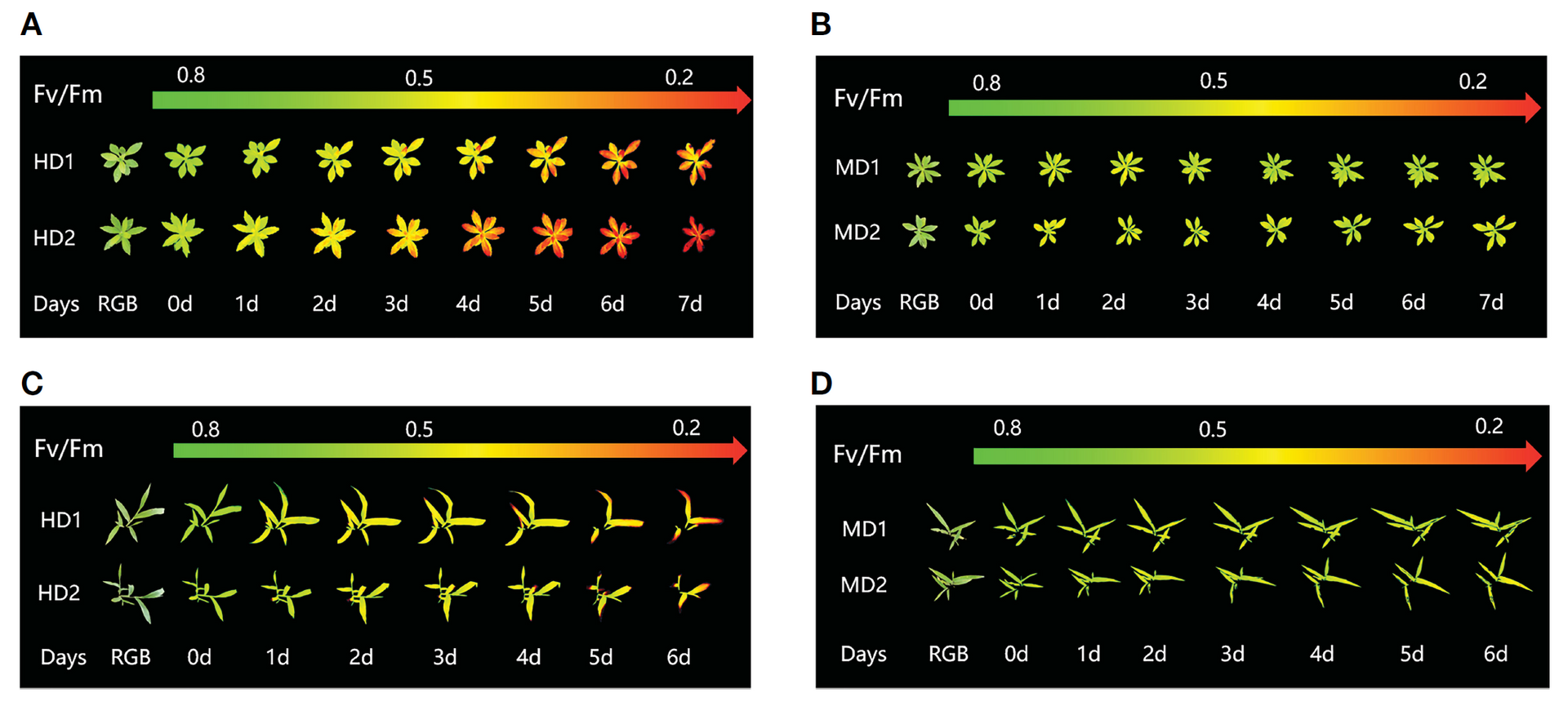
Fluorescence images of Fv/Fm parameters were captured daily during the experimental period, and the changes of Fv/Fm were monitored continuously. (A, B) shows the image changes of Fv/Fm in
Erigeron canadensis with different levels of mechanical stress, (C, D) shows changes of Fv/Fm in
Digitaria sanguinalis with different levels of mechanical stress.
The study’s most intriguing finding was the effect of combined mechanical and chemical stress. When weeds were subjected to both types of damage simultaneously, the photosynthetic inhibition rate (R) reached 71–73% after just three to four days—a level of damage comparable to seven days of chemical stress alone. This suggests that mechanical damage enhances herbicide efficacy by breaking the leaf cuticle, allowing chemicals to penetrate more deeply and act more rapidly. This synergistic effect underscores the potential of integrated weed management strategies that combine mechanical and chemical methods for more efficient control.
The implications of this research are significant for agricultural practices. By understanding how weeds respond to different types of stress, farmers can optimize their control strategies—whether through targeted herbicide application, mechanical weeding as a complementary tool, or species-specific approaches that account for variations in leaf morphology. Chlorophyll fluorescence imaging provides a real-time, non-destructive method for assessing weed stress, allowing for dynamic adjustments in weed management.
In conclusion, the study by Quan et al. (2023) highlights the value of chlorophyll fluorescence imaging in understanding and optimizing weed control. By revealing the hidden physiological responses of weeds to mechanical and chemical stresses, this research offers a scientific foundation for developing more effective, sustainable, and precise weed management practices.
For further details, we encourage readers to explore the original publication:
- Quan, L., et al. (2023). Monitoring weed mechanical and chemical damage stress based on chlorophyll fluorescence imaging. Frontiers in Plant Science. DOI: 10.3389/fpls.2023.1188981