Anthocyanins Uncovered: A Spectral Method for Stress and Senescence Detection in Plants
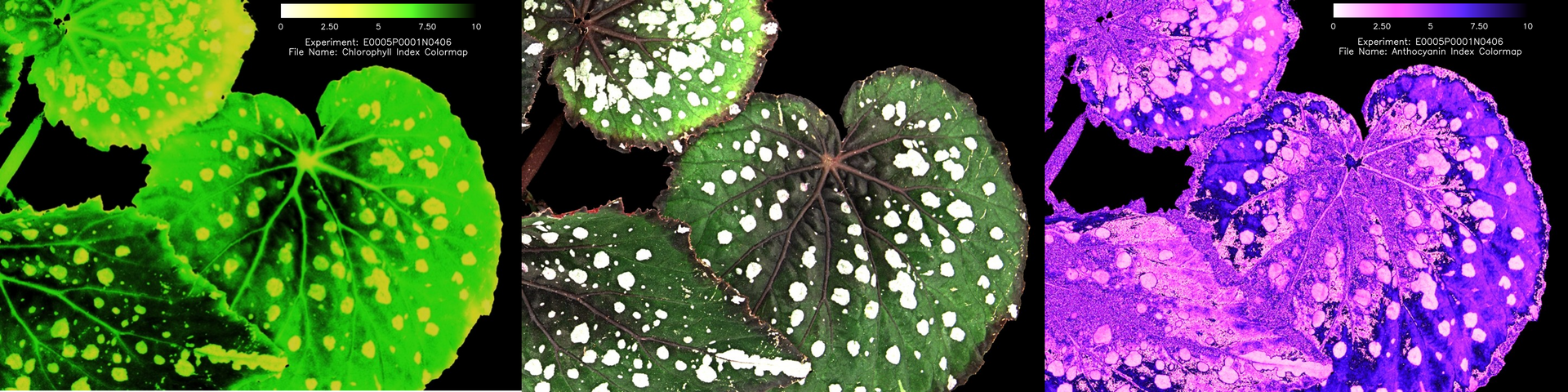
Anthocyanins (Anth) are water-soluble vacuolar pigments in higher plants, responsible for red coloration in leaves and often induced by environmental stresses such as UV radiation, drought, or nutrient deficiencies. Their accumulation serves as a marker for leaf stress and senescence, making their quantitative assessment valuable for understanding plant responses to environmental challenges. However, traditional methods for Anth estimation previously relied on destructive chemical extraction, which was time-consuming and impractical for large-scale or real-time studies. In their 2001 study, Gitelson et al. addressed this limitation by developing a nondestructive, reflectance-based method to estimate Anthocyanin content in intact leaves.

Gitelson et al. analyzed the absorption and reflectance spectra of leaves from four plant species; Acer platanoides (maple), Cotoneaster alaunica (cotoneaster), Cornus alba (dogwood), and Pelargonium zonale (pelargonium), across a wide range of pigment compositions. By comparing Anth-containing leaves to Anth-free leaves with matched chlorophyll (Chl) content, they identified a distinct absorption peak for Anth at 550 nm. This peak was linearly correlated with Anth content, establishing a direct relationship between spectral behavior and pigment concentration. However, the challenge lay in the spectral overlap between Anth, Chl, and carotenoids (Car) in the green region (500–600 nm), where Chl absorption is particularly strong. To estimate Anth accurately, it was necessary to account for Chl’s contribution to reflectance in this spectral range.
To isolate Anth’s spectral signal, Gitelson et al. developed the Anthocyanin Reflectance Index (ARI), defined as:
ARI = (R₅₅₀)⁻¹ – (R₇₀₀)⁻¹
where R₅₅₀ and R₇₀₀ are the inverse reflectances at 550 nm and 700 nm, respectively. The rationale behind this index is rooted in the optical properties of leaves:
- At 700 nm, reflectance is minimally affected by Anth but strongly influenced by Chl. In Anth-free leaves, R₅₅₀ and R₇₀₀ are nearly equal, and their inverse values correlate closely with Chl content.
- In Anth-containing leaves, Anth absorption reduces R₅₅₀, causing the ARI to increase proportionally with Anth content. By subtracting the Chl-dominated signal at 700 nm, the ARI effectively isolates Anth’s contribution.
This method was validated across multiple species and pigment compositions, demonstrating a high linear correlation (R² = 0.94) between ARI and analytically measured Anth content. The standard error of estimation was ≤ 3 nmol/cm² for Anth levels between 0.3 and 25 nmol/cm². For higher Anth concentrations (>25 nmol/cm²), where the ARI’s sensitivity decreases, alternative indices such as (R₅₅₀)⁻¹ or R_NIR/R₅₅₀ (where R_NIR is reflectance in the near-infrared) were proposed, achieving a standard error of <3.9 nmol/cm².
Gitelson et al. compared the ARI to the red/green ratio (Gamon & Surfus, 1999), a previously proposed method for Anth estimation. The red/green ratio, however, is influenced by Chl, Car, and Anth simultaneously, leading to a weaker correlation (R² = 0.55) and a higher standard error (10.2 nmol/cm²). In contrast, the ARI demonstrated 2.5× greater accuracy, making it a superior method for Anth estimation in intact leaves.
For further details, we encourage readers to explore the original publication:
Gitelson, A.A., Merzlyak, M.N., Chivkunova, O.B., (2001). Optical properties and nondestructive estimation of anthocyanin content in plant leaves. Photochemistry and Photobiology,74(1), 38-45. doi: 10.1562/0031-8655(2001)074<0038:opaneo>2.0.co;2.